
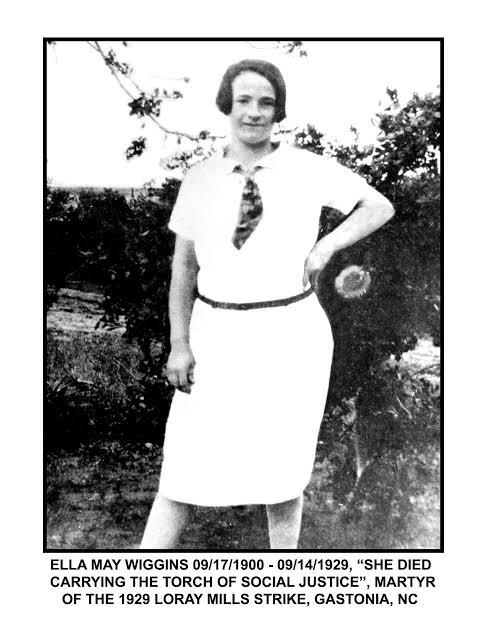
Ella May Wiggins was a Bessemer City textile worker, mother, and labor advocate whose life became an important part of North Carolina’s labor history during the late 1920s.
Ella May lived and worked in Bessemer City, where she was employed at the American Mill No. 2 (Dawn Processing Mill, located on E. Alabama Ave.). Like many textile workers of that era, she experienced firsthand the long hours, low wages, increasing workloads, and difficult working conditions common throughout the textile industry. As a mother raising a family with very limited resources, these challenges were deeply personal. She worked the night shift so she could care for her children during the day and, at one point, was supporting five children on approximately $9 per week. Her experiences as both a mother and a mill worker helped shape her determination to seek better opportunities and conditions for working families.
In 1929, Wiggins became involved in efforts by textile workers across Gaston County to advocate for higher wages, reasonable working hours, improved workplace conditions, and greater fairness for mill employees. She became known not only for speaking on behalf of workers, but also for writing and singing songs that described the everyday struggles of mill families. Her advocacy crossed racial lines at a time when segregation was deeply entrenched in the South. This made her a social justice pioneer and put a target on her back.
On September 14, 1929, Wiggins was traveling with other workers from Bessemer City to a labor gathering in Gastonia when the group was confronted and turned back. Their vehicle was pursued, and Wiggins was shot and killed. She was only 29 years old. Her death became a significant moment in North Carolina labor history and drew greater attention to the conditions facing textile workers and their families.
Today, Ella May Wiggins can be remembered as a working mother who wanted something better for her family and for other families like hers. Her story reflects courage in the face of hardship and a belief that people who worked hard deserved fair wages, safe and reasonable working conditions, and the opportunity to provide a better life for their children. Her connection to Bessemer City remains an important part of the community’s history and of the broader story of textile workers who helped shape our region. A new mural is being placed at the corner of 12th St. and Virginia Ave. in downtown Bessemer City and Ella May Wiggins is buried in the Bessemer City Memorial Cemetery.